
Think about the last time you had to chase a company about something that went wrong. Chances are the original problem wasn't what made you angry. It was the effort that came after: explaining the issue, getting passed to someone else, explaining it again, and wondering whether anyone actually had taken the time to understand the full story.
That is the idea behind customer effort, and it is one of the most useful lenses a service team can adopt. If you want to reduce customer effort, the place to start is rarely the front line. It's the handoff between teams.
In this article, we'll look at why handoffs create so much friction, where they usually break, and a practical five-step approach to fixing them, whether you handle ten enquiries a day or ten thousand.

What is customer effort and why does it matter?
Customer effort is how much work a customer has to do to get their issue resolved. It covers how many times they have to contact you, how often they repeat themselves, and how long they wait for a straight answer.
The concept was popularised by research into the customer effort score (CES), which asks customers a simple question after an interaction: how easy was it to get your issue handled? The finding that surprised many service leaders is that ease often predicts loyalty better than delight does. Customers rarely expect to be wowed. They expect not to be inconvenienced.
Transfers sit right at the centre of this. Every time a customer has to restart their story, the effort goes up, and the goodwill goes down. It also tells the customer something uncomfortable: your organisation doesn't share information internally, so I have to do it for you.
Why the handoff between teams is part of the customer experience
Most companies treat handoffs as an internal process. A front-office agent needs input from compliance, claims, finance or a technical team, so they ask for it, wait, and relay the answer. Internally, that looks like normal collaboration.
From the customer's side, it looks like silence.
They don't see the three emails going back and forth between departments. They don't know someone is waiting on a reply from the back-office. All they see is a clock ticking with no update. If they chase, they often reach someone who has no visibility of what's happening, and the cycle starts again.
That's why the handoff belongs in your customer experience strategy, not just your operations manual. It's a moment of truth that the customer never sees, but always feels.
Where handoffs break down
In most organisations that rely on email, the same four failure points appear again and again.
1. Nobody clearly owns the enquiry: When a query sits in a generic mailbox such as support or info it belongs to everyone, which means it belongs to no one. Two people may reply, or neither may.
2. The context lives in individual inboxes: The history of the issue is spread across forwarded emails, personal folders and people's memories. When the enquiry moves to a new person, the story doesn't move with it.
3. Internal back-and-forth is invisible: When the front-office asks the back-office a question, that exchange often happens outside the original thread. Managers can't see it. The customer can't see it. Nobody can tell how long the enquiry has been sitting in internal limbo.
4. Nobody is watching the clock across the whole journey: Service targets are usually measured on the first reply, not on the full journey from "Received" to "Completed". An enquiry can be acknowledged on time and still take a week to answer.
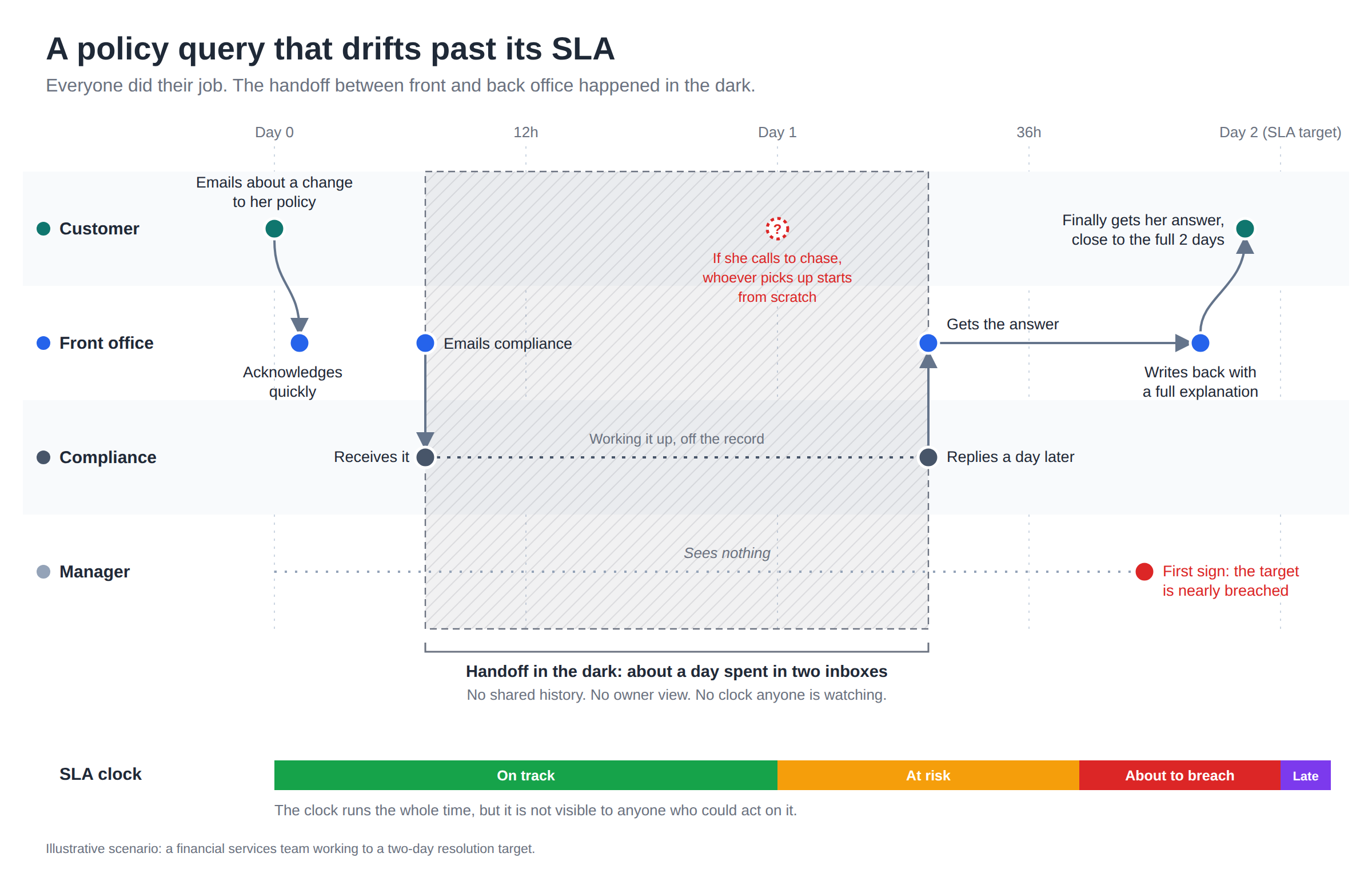
Here's an illustrative scenario of how this plays out in a financial services setting, with a two-day resolution target.
A customer emails to ask about a change on her policy. A front-office agent acknowledges it quickly, which is exactly what the process asks for. But answering properly needs input from the compliance team, so the agent emails them. Compliance replies a day later with the reason behind the policy position. The agent then writes back to the customer with a detailed explanation.
Every individual person did their job. Yet the customer waited close to the full two days, the manager saw nothing until the target was nearly breached, and if the customer had called midway, whoever picked up would have had to piece the story together from scratch.
The problem wasn't the people. It was that the handoff between front and back office happened in the dark.
Five ways to reduce customer effort at the handoff
1. Give every enquiry one owner
Assign a single accountable person to each enquiry from the moment it arrives. That person may need help from others, but they stay responsible for the outcome. If the owner is away, ownership should be transferable so the customer's experience doesn't depend on someone's leave calendar.
2. Keep the whole conversation in one thread
Every email, internal question, answer and follow-up should attach to the same enquiry, ideally under a single reference number. When a new person picks it up, they should see the full history in seconds. This one change eliminates the "can you explain the issue again?" moment.
3. Make internal handoffs visible and trackable
When an enquiry moves between teams, treat it as a tracked step, not a side conversation. The receiving team should have its own target and its own clear view of what's waiting for them. Managers should be able to see which items are in the back office, for how long, and who is holding them up.
4. Measure the clock end to end
Track response time and resolution time for the whole journey, and use colour coding or alerts to flag risk before a breach, not after. An enquiry that is amber on day one is a conversation. An enquiry that is red on day three is a complaint.
5. Use templates to keep communication consistent
When several people touch the same enquiry, tone and quality can vary wildly. Shared templates for common responses keep the customer experience consistent, whoever happens to reply.
What to look for in a email communication tool
If email is your main channel, a general-purpose shared mailbox usually isn't enough, because it has no concept of ownership, status or time. When evaluating a shared inbox or enquiry management platform, check whether it offers:
- A single owner and a visible status on every enquiry
- One reference number that chains all related communication together
- The ability to transfer ownership without losing history
- Internal escalation that is transparent to managers
- Response and resolution clocks measured against configurable SLA targets
- A full audit trail of who viewed, replied to or changed an enquiry
- No deletion of any enquiry or enquiry thread to be allowed
- Dashboards and reporting for team leads and executives
- Security and compliance fundamentals such as encryption and single sign-on
How Kunye Cloud approaches the handoff
Kunye Cloud is a South African shared inbox and SLA tracking platform built for exactly this problem. Incoming enquiries are captured automatically and allocated to an individual or team, each with one owner and a visible status. All communication, including follow-ups and internal queries, chains into the same enquiry under a single reference number, so nothing sits in someone's personal inbox.
Each enquiry carries a visible clock, measured in real time against your SLA targets and colour-coded so managers can see what's at risk before it breaches. Front office and back office can work to their own targets, with a clear view of workload and bottlenecks. Every action is recorded in an audit trail, which matters when you need to show a regulator or an ombud exactly what happened and when.
Kunye Cloud supports Microsoft 365 and Google Workspace mailboxes, so it fits the email setup your team already has.
How to know if your handoffs are improving
Pick a small set of measures and review them monthly:
- Customer effort score: ask customers how easy it was to get their issue resolved
- Repeat contacts: how often customers have to chase the same enquiry
- Touches per enquiry: how many people handle each one before it's closed
- Time in internal limbo: how long enquiries wait between teams
- SLA compliance: the share of enquiries resolved inside target, not just acknowledged inside target
If effort drops while resolution times hold steady, your handoffs are getting better.
Frequently asked questions
What is customer effort?
Customer effort is the amount of work a customer must do to get their issue resolved, including repeating information, following up, and being transferred between people or departments. Lower effort is strongly linked to better loyalty and fewer complaints.
How do you reduce customer effort in customer service?
Give every enquiry a single owner, keep all communication in one thread, make internal handoffs visible, measure response and resolution times from start to finish, and use templates to keep replies consistent.
What is a customer handoff?
A customer handoff is the moment an enquiry moves from one person or team to another, for example from a front-office agent to a compliance or claims team. How well it's handled determines whether the customer has to repeat themselves.
Why do customers hate being transferred?
Because transfers usually force them to explain the issue again and signal that the organisation isn't sharing information internally. The frustration is about the extra effort, not just the delay.
Can a shared inbox help with complaint handling?
A basic shared mailbox usually can't, because it doesn't track ownership, status or time. A purpose-built shared inbox with SLA tracking, ownership and an audit trail gives teams the visibility to handle complaints consistently.
Ready to stop making customers repeat themselves?
If your team handles enquiries or complaints by email and you'd like to see how a single owner, a single thread and a visible clock work in practice, book a Kunye Cloud demo.